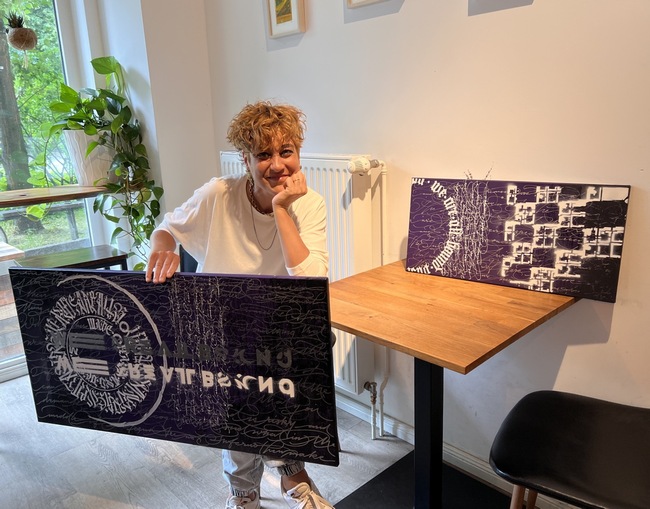
Andrea Villanis’ creative journey began in experimental theatre at the age of thirteen, where she developed a fascination with people, expression, and the stories carried by the human body. A background in modern philology deepened her interest in language and its power to shape how we understand ourselves and the world around us. Today, her work explores the connection between calligraphy and street art. Visitors to the Urban Nation Museum can experience one of those unique dialogues firsthand through her art, which transforms letters and words into powerful and compelling visual narratives.
That alone would have made her an intriguing interview partner, but her unusual path from theatre and philology to internationally exhibited urban art gave ANNA NOAH far more than one reason to sit down and talk with her.
Andrea, many thanks for giving us the opportunity to explore the way you see the world in this interview.
Thank you for getting in touch.
What exactly drew you to combining traditional lettering with urban expression? What inspired that idea in the first place? As an artist, you must have a strong imagination and a unique creative process. I’d love to hear more about what sparked this direction and how the concept developed for you.
I am a street artist, and part of my world comes from street art and the communities around it. My work combines that background with more classical approaches.
But I am also a scholar, which has given me a deep appreciation for words and language in particular. I am interested in how language can be deconstructed and reconstructed. What happens when writing is no longer curated in the classical sense? How does readability change? What draws people into a space? So, for me, there is a fascination with the relationship between space, constructed language, memory, culture, and time. I began using these ideas in my work as a way of connecting one thing to another. It was also an experiment. Especially in recent years, I have been asking myself: How can I be more human? How can I express the most human aspects of myself? How can I create work that is not driven by AI?
I was also influenced by a wonderful essay by Tim Ingold called Lines: A Brief History. It is a very insightful interpretation of how humans create and understand lines. He analyzes space and the history of lines, arguing that we begin with movement. Movement creates paths, borders, complexity, and gesture, all of which are deeply human. We start to read the city itself as a kind of text. We move from one point to another and imagine the straight line connecting them. In a certain way, that process humanizes our experience of the world.
I have a question about the exhibition at the Urban Nation Museum. Some of the lettering looked a bit like Sanskrit to me, which made me wonder whether that was intentional. Was the design inspired by a language or writing system from India, or was the similarity purely coincidental?
Yes, definitely. As I said, my artistic background comes from letters and handwriting and also from thinking about urban space. But over time, many different influences have found their way into my work. Arabic calligraphy, for example, has been a strong influence, especially the playful possibilities of working with the alphabet.
There is also a spiritual dimension to my practice. If you think about Sanskrit and other traditional writing systems, those influences are certainly present as well. So, your observation is absolutely valid. The work isn’t based on one specific language, but it is informed by a range of cultural, linguistic, and spiritual references.
Which artists, writers, or cultural movements inspire you the most?
There are many influences, but more than specific artists, I would describe my artistic journey as a series of encounters with different forms of expression.
It actually began with theatre. I was fascinated by the human voice, by people, and by the question of who occupies a space. In the beginning, I was involved with visual arts and scenography because theatre was a place of research and experimentation for me. It was where I began to develop my own artistic language and make my work more personal.
Later, I encountered graffiti and street culture. I started creating political works, and at that time I was often driven by anger and a rebellious spirit. That energy found its way into my artistic practice and became part of my visual vocabulary.
Looking back, I can recognize influences from many traditions. European artistic movements from the nineteenth and early twentieth centuries, a notable representative is Henri Michaux, or the North American artist Cy Twombly were important to me, but I was also deeply interested in Japanese and Chinese artistic traditions.
When I began studying at university, my academic work introduced me to a number of important thinkers. One of them was Roland Barthes. I was particularly influenced by his essay Empire of Signs, in which he reflects on the differences between Western and Eastern systems of writing and meaning. His ideas encouraged me to think more deeply about language, symbols, and the ways we interpret visual forms.
How would you describe the relationship between calligraphy and street art in your work?
In general, there is this tendency to rationalize everything. But writing exists in between these states. I would say it can be understood as a kind of technology of meaning, but at the same time it is also a very static, visual experience. In my work, I began to imagine the city as a palimpsest, which is essentially a manuscript or parchment that has been written on, erased, and written over again. It is a material process, and material is very important in this context. The surface, the paper, the layers all matter. It is like rewriting, or redrawing an image again and again.
All these visible layers remain present at the same time. This means writing beyond writing. It led me to imagine the city as a structure of layered inscriptions.
When I worked with another curator, for example, I encountered ideas where like reflections in water, and fragments of urban culture, became part of the experience. I remember entering a space and thinking that it felt like entering a city itself. From there I began to develop the idea further. I worked with inspiration from installations and data-driven environments, and I started to re-imagine and reconstruct the layers of the city inside an exhibition space.
Curated by Michelle Houston.
photo by Nika Kramer
@nikakramer
@Urbannation_Berlin
Yes, and I think that’s what makes your work so fascinating. And speaking of lettering, I think a lot of street art lettering isn’t as refined or visually striking as yours. [She smiles.] What usually comes first in your process: the word, the emotion, or the visual composition?
It adds a lot to the work. In the case of the artwork you saw in the Urban Nation Museum, there was a proposal and a specific context behind it. I started by brainstorming: What is the city for me? What does it mean? This is quite an old question, but I wanted to approach it through a kind of layered thinking, through lines and traces.
At that time, I began to imagine the city in a moment of crisis. Cities today feel fragmented, overloaded, and full of overlapping languages and signals. We don’t always fully understand them anymore, and I wanted to respond to that condition in my work.
At the same time, there is also a desire from the people, something collective and unspoken. I was influenced by proposals such as the Shenzhen project.
Perhaps this came from the fact that I was in a personal moment of change, and I felt very grateful for that. I started to think about the connection between all the people on the streets, how we are all bound together across past and present, across different times and experiences. We move through the city, and in a way we »write« it with our steps. That is part of how I reflect on my creative process: I listen to impulses at the right moment and then develop them according to my interests.
I also worked with Mind Design, where the focus was on the relationship between space, memory, rhythm, and gesture.
I like to transform the rhythm of repeated words into visual mantras. You can still detect the repetition and the shared meaning, but something shifts in perception — it becomes a matter of attention. In a way, it works like a mantra studied in neuroscience. You can look into that, of course. It operates even when you don’t fully know it consciously. What matters is the sound or rhythm itself, the way it resonates. And then, in some sense, you just know.
If there’s no external proposal, do you sometimes just wake up at night and think, »Oh, I have an idea«? Or is it more like it doesn’t really work that way?
I like that question, because for me it is sometimes exactly like that — but only sometimes. Over time, I’ve realized that a big part of my practice is daily work. I show up to an appointment with myself. It’s not only about moments of sudden inspiration, when you »see the lines« of an idea but cannot fully grasp them yet. If you don’t maintain that discipline, if you don’t commit to your practice every day, you can’t sustain the level of energy and engagement that research and creative work require. Inspiration alone isn’t enough to carry it. Of course, there are moments of unexpected insight, but they don’t exist in isolation. From my experience, they emerge within a continuous process of work and attention.
At the same time, you never really know where an idea comes from. It might arrive uninvited, without any clear trigger. That uncertainty is also part of the process.
Are there certain words, phrases or motives you return to again and again in your work?
There has been a major shift in my life over the last six to seven years. I would say I’ve gradually become a different person through that process, shaped by time and experience. It was a very important and, in my view, meaningful turning point.
I was deeply influenced by certain ideas about connection — how lives are intertwined, how people are linked across time and space. There is a sense that our lives are not entirely our own, but are part of something larger, something shared and continuous. This idea resonates strongly with me. The more I think about it, the more connected I feel to that kind of reality. For me, it is about giving voice to something that already exists in a quieter form, and making it visible to others. That becomes part of the writing itself, but also part of the energy behind it.
A similar impression came to me when I saw Cloud Atlas. I was very affected by it, even though I haven’t read the book yet. It wasn’t only about the movie itself, but about the feeling it created. It is a complex work, with its jumps across time and narrative layers. At first it can feel confusing, but gradually you begin to recognize the connections. The same actors appear in different roles, and these repetitions create a sense of continuity across time.
What stayed with me was not a question of beauty, but of structure and relation. As a scholar as well as an artist, I am very interested in these historical and cultural layers. I’ve studied ancient texts and traditions, and I find them deeply fascinating. In a way, this also connects to other readings and influences I’ve had along the way. It felt like a journey through time, through ideas, and through different forms of understanding.
How do people typically react to your work when they encounter it?
I am still trying to find a way to make my work feel like a kind of computational journey.
Sometimes people react strongly to it, almost overwhelmed, and they remain very attached to the words themselves. They ask: »What did you write there?« They try to find a key to understanding it, a single point of entry.
But I am not aiming for something fixed like that. I am not trying to define one clear message that everyone has to stand in front of and decode in the same way. I also want to leave space for interpretation. In that sense, I complete my part — and then it becomes yours. You engage with it, you look at it, you respond to it.
That is what I like about it.
[She smiles again.] If I had chosen realism, I would have gone in a different direction, but that was never my starting point. It might look familiar or even figurative at times, but that is not the goal. Instead, I am interested in finding a style that connects different states of perception and understanding, something that moves between systems, languages, and ways of seeing.
Are there elements of Italy (such as architecture, typography, or history) hidden inside your work?
Yes, of course. I am strongly convinced that I am structured around a certain kind of tension, almost a state of violence in the sense of intensity and force. I feel connected to geometry and to language, especially Italian words, and to ideas of proportion and form. There is something quite romantic in that, perhaps even excessive at times.
I come from a city that is not large, but significant in its own way. It is the third-largest city in Italy, and that background matters to me. The scale of a place changes how you see things, how you think, and how you create. I am interested in how different environments shape perception. I would not have been able to produce the same kind of work in a completely consumer-driven context. My practice has always been tied to specific places, histories, and transitions.
The city I come from has layers of history. It was founded in ancient times, influenced first by the Greeks, later by the Romans, and shaped by many different periods of domination. Today, you can still read those layers in its structure. In a way, that creates a kind of harmony. It is a melting pot of histories and influences. And I think that is one of the reasons why this idea continues to resonate with me.
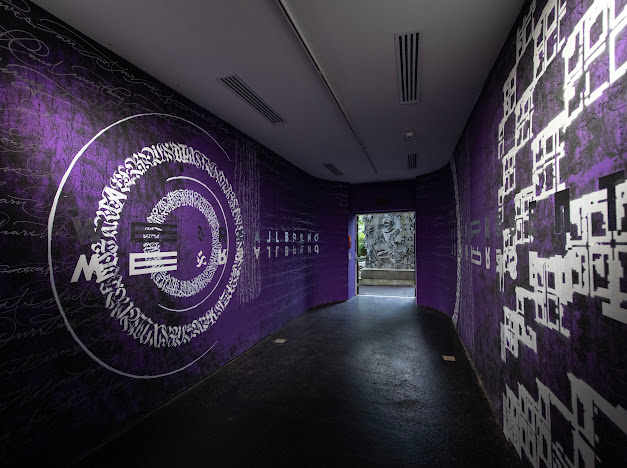
Curated by Michelle Houston.
photo by Nika Kramer
@nikakramer
@Urbannation_Berlin
What dream project would you love to create one day?
I never thought about it before. I love the idea of a »dream project«, but I am not really interested in a fixed dream movement. I am in a moment of life where I feel more spiritual, and at the same time more open to what the work itself wants to become. There is a kind of pressure, but not in a negative sense. It is more like a need to put things into order within a certain phase of life. So I continue working, and I trust that things evolve by themselves, sometimes even without my direct intervention.
I believe that if you try to create something meaningful for the world, you also have to remove yourself as the center of it. The work should not be about me as an individual problem or ego, but about something broader — about human beings, about nature, about everything that is involved in that system.
For me, kindness is central. Kindness in everyday gestures, in how you move through a space, how you position yourself in relation to others, how you speak and interact. I do not explicitly put this into my work as a theme, but it is something that is embedded in my life and therefore naturally flows into it. In that sense, there is a certain ease that comes from it.
At the same time, I used to work in a much more politically direct way. I started with street art, coming from anger, frustration, and a need to shout into the public space: »Hey, what are we doing?« But over time I reached a point where I started questioning my own position: What am I actually doing, and why?
Have you ever created a piece that felt too personal to leave in public? You don’t need to share it, if it feels uncomfortable.
I am quite generous in what I share, but I also believe in letting things go. Many artists struggle with that, but for me it is connected to my background in theatre, where impermanence is part of the process. Things are performed, they exist for a moment, and then they disappear. That idea of transience has stayed with me. At some point, I realized that political energy does not necessarily need to be expressed as direct confrontation anymore. It can also be internalized. It becomes a different kind of gesture, a different form of attention.
For me, the political aspect has shifted inward. It is less about external provocation and more about how things are organized, revealed, or slightly disrupted from within. And even if the work once came from a very provocative place, I think that has changed. It is not about shock anymore, but about presence, relation, and awareness.
The last question is always dedicated to my Mom—she tells me to ask everyone: What is your favorite food here in Germany?
Schnitzel!
[She smiles broadly.]
And in Italy?
This is more difficult. Maybe it’s something like a simple dish — like fried fish, served in some kind of cardboard box or street food packaging. I like fish with light seasoning, pepper and something a bit lemony. It’s more of a simple, slightly street-style meal, not something very refined. Just fresh fish, a bit of spice, and something that feels light. It’s actually interesting—it’s the first time I’ve really thought about it like this.
Andrea, so many thanks for this interview!
Thank you! I am honored to be a part of TITEL kulturmagazin.
And most importantly, visitors often sense the unconditional love Andrea puts into her work.
| FOTOS EXHIBITION: NIKA KRAMER
| FOTO ANDREA: ANNA NOAH
Born in Naples, Italy, Andrea Villanis, better known as Drew.Lab_One, now lives and works in Berlin.
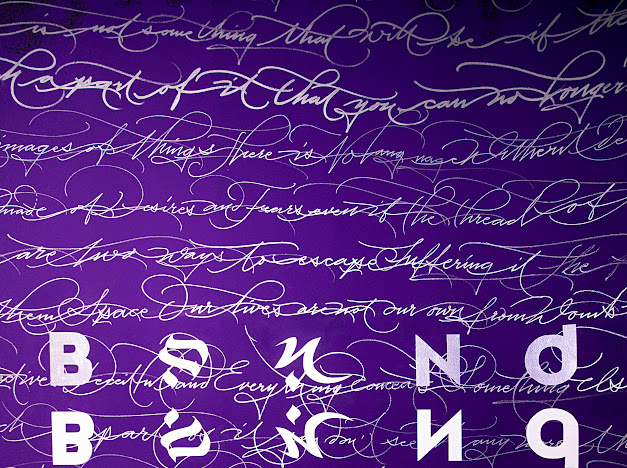
»Love Letters to the City« is a permanent exhibition at Urban Nation Museum (2024–2027): Drew.Lab_One contributed »Made of Desires and Fears,« a piece that plays with the dual meaning of »letter«—as both correspondence and alphabet character. The work is a collage of quotations from Italian author Italo Calvino, rendered in a calligraffiti style that intertwines various scripts from different eras and cultures. This fusion symbolizes the architectural and cultural diversity of Berlin, portraying the city as a resonant entity shaped by the desires and fears of its inhabitants.